Including An Arizona Premiere!
Raymonda Variations
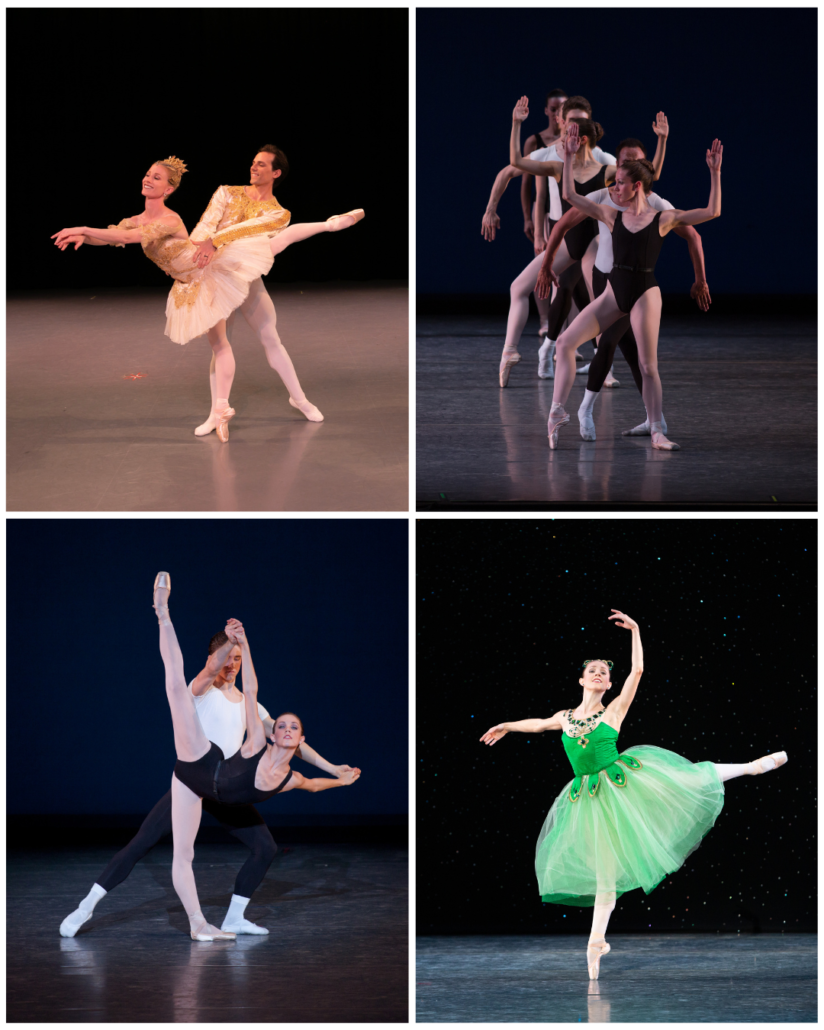
Experience this Arizona premiere! Throughout his life, Balanchine was attracted to Glazunov’s music for Raymonda. He loved what he called the music’s “grand and generous manner, its joy and playfulness.” As a student in St. Petersburg, Balanchine danced in the Mariinsky Theater production that had originally been choreographed by Marius Petipa. After leaving Russia, Balanchine and the ballerina Alexandra Danilova mounted the full-length Raymonda for the Ballet Russe de Monte Carlo in 1946. At New York City Ballet, Balanchine produced three works to portions of the Raymonda score: Pas de Dix, Cortège Hongrois, and Raymonda Variations. The music in Pas de Dix and Cortège Hongrois was taken mostly from the last act of Raymonda. For Raymonda Variations, Balanchine drew on music from the first act.
Emeralds
Emeralds is one section of Balanchine’s full-length, three-act plotless ballet Jewels. Balanchine considered Emeralds “an evocation of France — the France of elegance, comfort, dress, perfume,” recalling the 19th century dances of the French Romantics. Gabriel Urbain Fauré (1845-1924), was Maurice Ravel’s teacher, and his life and work bridged the eras of Romanticism and Impressionism. He wrote piano and chamber music as well as incidental music for plays such as Pelléas et Mélisande and Shylock; he composed operas and many songs set to the words of French poets of the late nineteenth century, especially Verlaine.
The Four Temperaments
Subtitled “A Dance Ballet Without Plot,” The Four Temperaments is an expression in dance and music of the ancient notion that the human organism is made of four different humors or temperaments. Each one of us possesses these four humors, but in different degrees, and it is from the dominance of one of them that the four physical and psychological types melancholic, sanguinic, phlegmatic, and choleric — were divided. Although the score is based on the idea of the four temperaments, neither the music nor the ballet itself makes specific or literal interpretation of the idea.
George Balanchine © The Balanchine Trust